Saturday, April 9, 2016

Nutrition Screening Event!

Well that was an adventure! The three of us planned a nutrition education and screening event for the community of Mongu. Event planning in Zambia is very different than it is in Canada. Every errand takes extra steps. For example, when you need to get things laminated or printed it takes about eight different stops. Luckily the taxi drivers in Mongu are amazing, especially Mike! He took us on all of our errands and would barter, translate, laminate, navigate, and even chop wood! We could not have done all these necessary tasks without Mike by our side. The house moms at Liseli Lodge were another huge help for this event! All the posters we made had to be translated into the local language, Silozi, and the house moms were more than willing to help out.

The day of the event was very exciting. There were six stations that community members would visit. Up first was the screening station which looked for malnutrition based on measuring arm circumferences and body weights. Based on what we found, we would refer patients to the Save a Life clinic if they were moderately malnourished or Lewanika General Hospital if they were severely malnourished. After being screened, next up were the education stations on infant care, childhood nutrition, obesity, and hygiene. Once properly educated, people could visit the nutrition station, where we displayed examples of healthy and unhealthy food, as well as the cost to show that it could be purchased on a budget. We also served maize meal porridge with groundnuts (a common high protein nut found in Mongu) with the help of the lovely Save A Life clinic staff. In addition to all the other stations, we also a blood pressure station where we screened for hypertension and would refer based on WHO guidelines.

The day of the event was the windiest day we have had in Mongu and the posters and tablecloths were flying everywhere! Within an hour we had children swarming and long lines forming along at the screening station. We were so excited to see this! It was awesome to see that moms and their babies were present and would sit at the education stations for 20 minutes because they really wanted to learn what we had to teach. People were really interested in the information as this type of event does not often happen in Mongu. We had the Zambian nursing students, public health students, and nutrition students helping at the event. This was a great help at all the stations as well as for translating and crowd control. At the end of the event the malnutrition screening station had screened over 500 people and the blood pressure station over 90. We were so proud of these numbers and the community response to the event.

We were able to donate a lot of the supplies and posters to the wards at the hospital after the event. The next day, we learned that a mom had already taken her baby to the Save A Life clinic based on our referral! What a proud moment for us.

This event was a once in a life time opportunity and we were so grateful to be able to take part in it. We learned so much working along side Zambian healthcare workers and were very excited to make a difference in the community that has welcomed us with open arms. It is a bittersweet moment getting ready to leave Mongu but we are all excited to start our careers as Registered Nurses!

With love from Mongu,

Jasmine, Michelle, and Dana
(Jasmine, Michelle, and Dana)


(A big thank you to all of the wonderful Save a Life staff!)

(Everyone is excited about the activity station!)

(Canadian and Zambian nursing students working together at the education station)

(Making groundnut porridge)

(In line waiting to be screened for malnutrition)

(Food Station)


Ituku Village Outreach

Our last week in Zambia was certainly a highlight for the 3 of us. With a fantastic team of people: Dr. Nilene, and our translators, Banks and Gift, we set out with a jam-packed truck off into the unknown.  We drove 2 hours out of Mongu, down a sand road, through 6 foot tall grass to rural Ituku village. Our camp for the week was a collection of tents underneath a tree near the chief's home. 


This particular village had no established clinic, so we set up some handmade reed mats underneath a large, shady mango tree. We didn't even have tables or chairs.  Our "pharmacy" was a group boxes on a blanket, and our "exam room" was a camping stretcher behind a reed mat screen for privacy. At any given time, one of us was screening patients for their names and ages, two of us, with the help of our translators, assessed, diagnosed and prescribed medications to our patients as Dr. Nilene oversaw the whole thing and stepped in to help as needed.  By the end of the 3 days of clinic, we had seen 483 patients. 

Given our lack of physical clinic building we had a constant audience of villagers, patients waiting to be seen and local children, who got great entertainment out of saying "encha" to the makuwas over and over again. 

It was a challenging and eye-opening experience to realize that all of these people have very little access to health care.  Many of them have chronic health issues like extremely high blood pressure that could be very well managed with diet education and medication. Some individuals had even had strokes from their high blood pressure and still it wasn't treated.  However, treatment is difficult with the closest clinic located about 10 kilometres away (a 4 hour walk one way, in the sand!). It simply isn't practical for them to walk all that way on a monthly basis to receive the care that they need.  

Even in the short time we were there we saw the fruits of labour. The very first morning we arrived we saw a little girl whose eye was clearly infected. We prescribed her eye drops and by the time we left, her eye looked significantly less swollen and red.  


It was remarkable to realize the impact that a simple 3-day clinic can have, but it is also frustrating to realize that they only receive care like this once or twice a year.  Each night, we held campfires for the villagers and we hope that it was not only a fun evening activity, but a reminder to them that there are people out there who really value them and see their health as a priority.

We were so grateful to be so well supported by Nilene, Gift, and Banks, and will never forget this memorable week.  


Remember, Toho Mutokoko, 

Laura, Sydney, and Montana


Last week as student nurses at Save a Life Centre.


For our final week of practicum, we were placed at the Save a Life centre. This facility runs a feeding program for malnourished children as well as a community clinic. The compound also holds the Village of Hope, which includes a school and orphanage.

The first day we accompanied Community Health Workers on home visits. Jamie visited homes along the harbour and Julianne visited homes further inland.  During these visits we checked up on children who were enrolled in the feeding program to assess hygiene, living conditions, and the physical health of the child. We were both thankful for the opportunity to see and better understand the way of life for families in Mongu.
Jamie providing teaching on STIs
The last two days we alternated working in the malnutrition centre and the community clinic. At the malnutrition centre we assisted the staff in weighing children and babies, distributing nutritious food, and teaching caregivers about STIs. Each week the caregivers are offered education on different health topics. We were pleased to see that the majority of children who came in were slowly and steadily putting on weight. We could see what a great resource the centre was to the community and what a difference it has made to many families.

Village of Hope community clinic
In the clinic, we spent the majority of the day testing, diagnosing and prescribing medications for patients (mostly children) who came in with malaria. We saw a wide variety of symptoms, from patients appearing almost healthy to looking feverish and nearly unable to stand. We also worked closely with the doctor on site to assess and treat patients with other complaints. Although the clinic had limited resources, it was well organized and provided effective care.

Julianne in the screening room where we cared for patients with malaria

Staff members from Save a Life Centre
 It's hard to believe that this was our last clinical placement ever. It was eye-opening, enjoyable, and offered us unique learning opportunities. We had an amazing experience in Mongu and are now looking forward to beginning our careers as Registered Nurses.

Jamie and Julianne

Friday, April 8, 2016

Similarities Despite Differences

For my last week of clinical (ever!) I was on the medical ward at Lewanika General Hospital. I was excited and nervous for this placement, as I had heard from my fellow nursing students that it was a very different experience than the medical wards in Canada. I've spent a lot of time working on medical wards in Canada, and hope to work on one when I graduate. So while I was eager to experience medical nursing in Zambia, I was nervous about what the day would look like and what the patient's diagnoses would be.

When I walked onto the ward, I saw clean, bright spaces and friendly, knowledgeable staff. I instantly felt at home. As we were doing rounds with the doctors and discussing patient diagnoses, I found that a lot of cases were familiar to me, but one patient particularly stood out to me. She was a young woman who was in the hospital with liver failure and ascites. She brought to mind a patient who I cared for in Canada, who also had liver failure and ascites. But while his liver failure was caused by hepatitis (a common cause of liver failure in Canada), her liver failure was caused by bilharzia. Bilharzia is a fluke that lives in freshwater snails, and it can infect people swimming or bathing in infested water by entering the body through the skin or urinary tract. Bilharzia can then infect any organ; for this patient it was her liver. Although it is easily treatable this patient showed signs of major liver damage. I don't know her entire story or how she got to this stage, only that she was now in the hospital.

While the treatment for liver failure and ascites is the same in Canada and Zambia, the resources available in the two countries are very different. This means that these two patients, in their respective countries, will likely have different outcomes.

It really hit me this week how much of a difference resources make, and the options that were available in this situation made it difficult for me to care for this patient. I found that I kept wishing we were in Canada so I could do more - something that I've thought more than once during this practicum. But the healthcare team here continually surprise me with their ingenuity and resilience. They daily care for their patients, in a difficult setting, and they do it with joy. I know that I have a lot to learn from them. Throughout this practicum I have been learning, not just about different diseases and their processes, but also how to keep working in difficult situations and how to solve a problem when it seems like there are no answers. Thinking outside the box has been given a whole new meaning to me.

I don't know what will happen to the young woman I saw at Lewanika. I also don't know what happened to the man in Canada. I do know that all we can do is our best, despite the resources we have in our our hands. Zambia has given me many lessons, but I believe that one of the most important ones is that we are all similar. The details might be different, we might have different accents and nationalities, but at the end of the day we are all just people, living our lives.

I'm so grateful I applied for and was accepted into this international practicum. I have been given a different perspective, and I believe that this experience will shape the rest of my nursing career.

With love,
Cass

Tuesday, April 5, 2016

Loving L&D!

This week in clinical was what I was most excited for, labour and delivery! I was joined by Zambian nursing students and midwifery students and the births I was able to assist with were absolutely thrilling. While in labour, most of the Zambian women remain very quiet and stoic, compared to Canadian women who are encouraged to express their emotions. I was told by one of the midwifery students that this is because Zambian women are told that if they scream it is not good for the baby. I did many newborn and mama assessments, and on my last day I was able to assist the midwife even more during the birthing process. I have incredible respect for the strength of the women here, especially those who are my age giving birth! 

I also had the opportunity this week to spend a day at the Save A Life centre, another placement I was very excited for. The day was spent doing home visits and checking up on the children. I was fortunate enough to be invited into a family's home and really see how the people of Mongu live. The staff at Save A Life were so welcoming, and I was able to sit in with a doctor and diagnose and treat some patients! It was an amazing learning experience. 

Much love from Mongu,
Dana

Exploring Psychiatric Care in Zambia

Throughout my time in Africa I had the opportunity to work in female, male, and OPD psychiatric wards. I am very passionate about working in psychiatry and have experience working as an Employed Student Nurse in the Vernon Psychiatry ward last summer. In Zambia the psychiatric patients are split up into female and male wards as many other wards at Lewanika General Hospital. To become admitted, the patients see a psychiatric clinical officer in the Psych OPD. A psychiatric clinical officer acts as a psychiatrist in Canada - prescribing, diagnosing, admitting, and discharging patients. As seen in other parts of the hospital, the patients family are required to supply food, clean clothes, and hygiene products. This is also the same case for both psychiatric wards. Often the family is unable to supply food, clothing, and soap since there is a large stigma associated with mental illness in Zambia. I was able to bring t-shirts and hygiene products that were generously donated for our practicum and they were very well received on the wards. The staff were very grateful and stated that these donations would make a huge difference for the patients. When I went back to the ward at at a later time the patients were already wearing the shirts! It is very interesting see what we often take for granted in Canada can make such a difference here. I am so grateful that I was able to work with the very knowledgable staff on the psychiatric wards. It was an eye-opening experience to see the difference in conditions of psychiatric hospitals compared to Canada, but it was encouraging to see that the staff were very passionate about decreasing the stigma that is often associated with mental illness.

Sending love to all my family and friends back home!

-Michelle Nurkowski


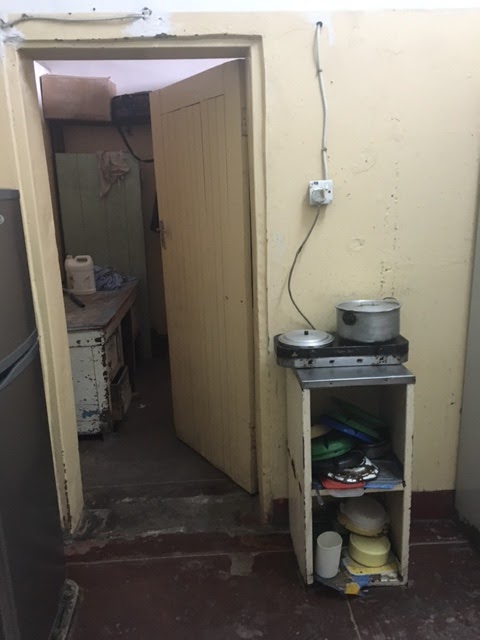
(Staff room with hotplate)

(Yearly diagnosis chart in male psychiatry)